









Why are water hardness and alkalinity often measured as CaCO₃?
Water hardness and alkalinity, seemingly different indicators, are both typically expressed in terms of equivalent amounts of calcium carbonate (CaCO₃).
I. What are hardness and alkalinity?
Hardness: Primarily refers to the concentration of calcium ions (Ca₃⁺) and magnesium ions (Mg₃⁺) in water. These ions primarily originate from the dissolution of minerals such as limestone (primarily composed of CaCO₃) and gypsum in strata. High hardness can lead to scaling (water scale) and reduced soap efficiency.
Alkalinity: Refers to the total amount of substances in water that can accept hydrogen ions (H⁺), or its ability to neutralize acids. These substances primarily include bicarbonate (HCO₃⁻), carbonate (CO₃²⁻), and sometimes hydroxide (OH⁻). Alkalinity is a key indicator of water's buffering capacity and is crucial for pH stability.
II. Why choose CaCO₃ for measurement?
We can think of "measured in CaCO₃" as the "dollar" of international trade. Each country has its own currency (denoted by different ions), but for ease of comparison and settlement, everyone uses a single, universally recognized, stable currency (CaCO₃).
1. History and Inheritance of Custom
Water Treatment and water quality analysis are ancient disciplines. In the early days, scale (boiler and pipe fouling) was one of the first water quality issues people focused on. Scale is primarily composed of calcium carbonate (CaCO₃).
Thus, the earliest water quality analysts naturally used CaCO₃, which is directly related to scale, as a scale to measure the total amount of scaling ions (namely Ca²⁺ and Mg²⁺). This convention has persisted and has been extended to the expression of alkalinity.
2. Great Calculation Convenience
This is the most crucial point. Using CaCO₃ as a unified standard allows the concentrations of different ions to be added and compared, greatly simplifying calculations and expression.
Unified molecular weight and equivalent weight: The molecular weight of CaCO₃ is exactly 100 g/mol (Ca: 40, C: 12, O: 16 * 3 = 48), and as a divalent salt, its equivalent mass is 50 g/eq (100 ÷ 2). This is a very neat number that is easy to mentally calculate and convert.
Simplifying water treatment dosage calculations: One of the core processes in water treatment is "softening" (hardness removal) and "pH/alkalinity adjustment." These processes are essentially chemical reactions, and the dosage of the chemical must be calculated based on equivalent relationships.
For example, the commonly used softening method, the "lime-soda process," involves adding lime (Ca(OH)₂) and soda (Na₂CO₃), which removes Ca₂⁺ and Mg⁺ by precipitating them as CaCO₃ and Mg(OH)₂. For overall chemical dosage design and sludge volume estimation (primarily CaCO₃), it is most intuitive and convenient to use CaCO₃ as the basis for calculations.
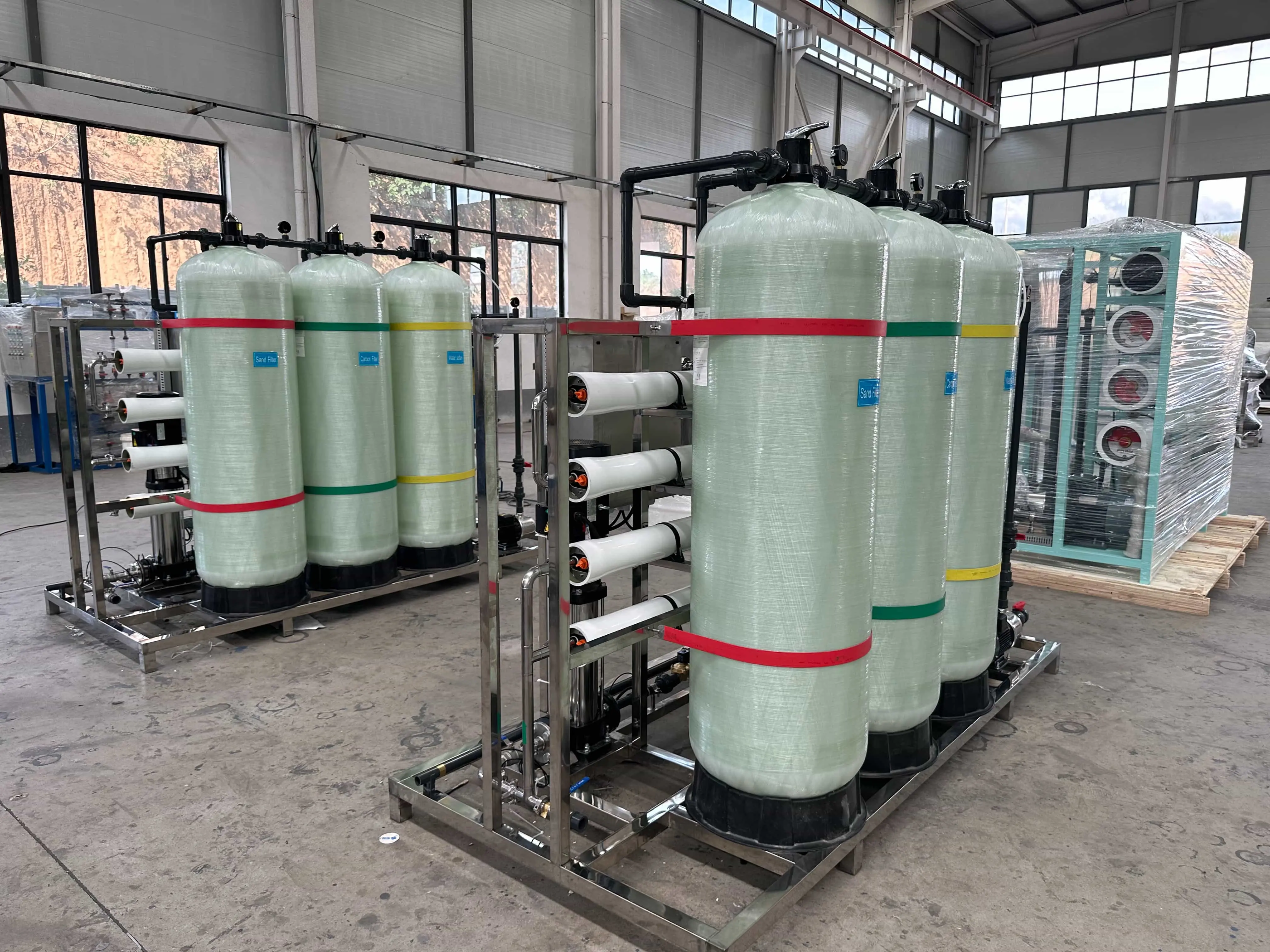
Zhongjing Explanation - What are Hard Water and Soft Water? _Zhongjing Environment_Carrier Central Air Conditioning Sichuan General Agent_Sichuan Zhongjing Environmental Construction Engineering Co., Ltd.
3. Chemical Connection
Hardness and alkalinity do not exist in isolation in water chemistry; they are closely linked through the carbonic acid equilibrium system.
The most important source of alkalinity in water is bicarbonate (HCO₃⁻), and the primary source of HCO₃⁻ is the reaction of calcium carbonate-containing rocks with water containing dissolved CO₂:
CaCO₃ (s) + CO₂ (aq) + H₂O ⇌ Ca²⁺ + 2HCO₃⁻
This equation is fundamental to understanding groundwater and surface water chemistry. It clearly demonstrates that hardness ions (Ca²⁺) and alkalinity ions (HCO₃⁻) are twins, often co-produced in a ratio close to 1:2 (equivalence ratio). Their common source and "standard form" is CaCO₃. Therefore, using CaCO₃ to measure both is chemically very relevant and intuitive.
4. Intuitiveness in Practical Application
For engineers and operators, stating "100 mg/L of hardness needs to be removed (as CaCO₃)" is much simpler and clearer than stating "40 mg/L of Ca²⁺ and 12 mg/L of Mg²⁺ need to be removed (assuming the ion ratios are unknown)." They can directly use this value to select treatment equipment and calculate chemical dosages.
Harmonization of Water Quality Standards: The limits given in various water quality standards (Drinking Water, boiler water, and circulating cooling water) are a single number when expressed in CaCO₃. Using individual ion concentrations instead requires listing multiple standards, which cannot directly reflect their combined effects and can cause confusion.
III. How to Convert?
The conversion formula is the essence of unification:
Concentration (calculated as CaCO₃, mg/L) = ion concentration (mg/L) × (equivalent mass of CaCO₃ / equivalent mass of ion)
Where equivalent mass = molecular weight / ion charge
Equivalent mass of CaCO₃ = 100/2 = 50
Equivalent mass of Ca²⁺ = 40/2 = 20
Equivalent mass of Mg²⁺ = 24.3/2 = 12.15
Equivalent mass of HCO₃⁻ = 61/1 = 61 (it is a monovalent ion)
Example:
Hardness conversion: A water sample contains 30 mg/L of Ca²⁺ and 10 mg/L of Mg²⁺.
Total hardness (calculated as CaCO₃) = 30 × (50/20) + 10 × (50/12.15) ≈ 30 × 2.5 + 10 × 4.11 ≈ 75 + 41.1
= 116.1 mg/L
Alkalinity conversion: The bicarbonate (HCO₃⁻) concentration of a water sample is 122 mg/L.
Total alkalinity (calculated as CaCO₃) = 122 × (50/61) ≈ 122 × 0.82 ≈ 100 mg/L
As you can see, this conversion brings the contributions of different ions onto the same scale.