







What common instruments are needed for reverse osmosis systems?
1. Temperature meter:
The water supply temperature meter needs to be tested because the water production is related to temperature in order to find out the standardized water production. Large equipment should be recorded. In addition, the temperature exceeding 45°C will damage the membrane element, so the raw water heater system should be set with an over-limit alarm, over-limit automatic drainage and RO shutdown protection.
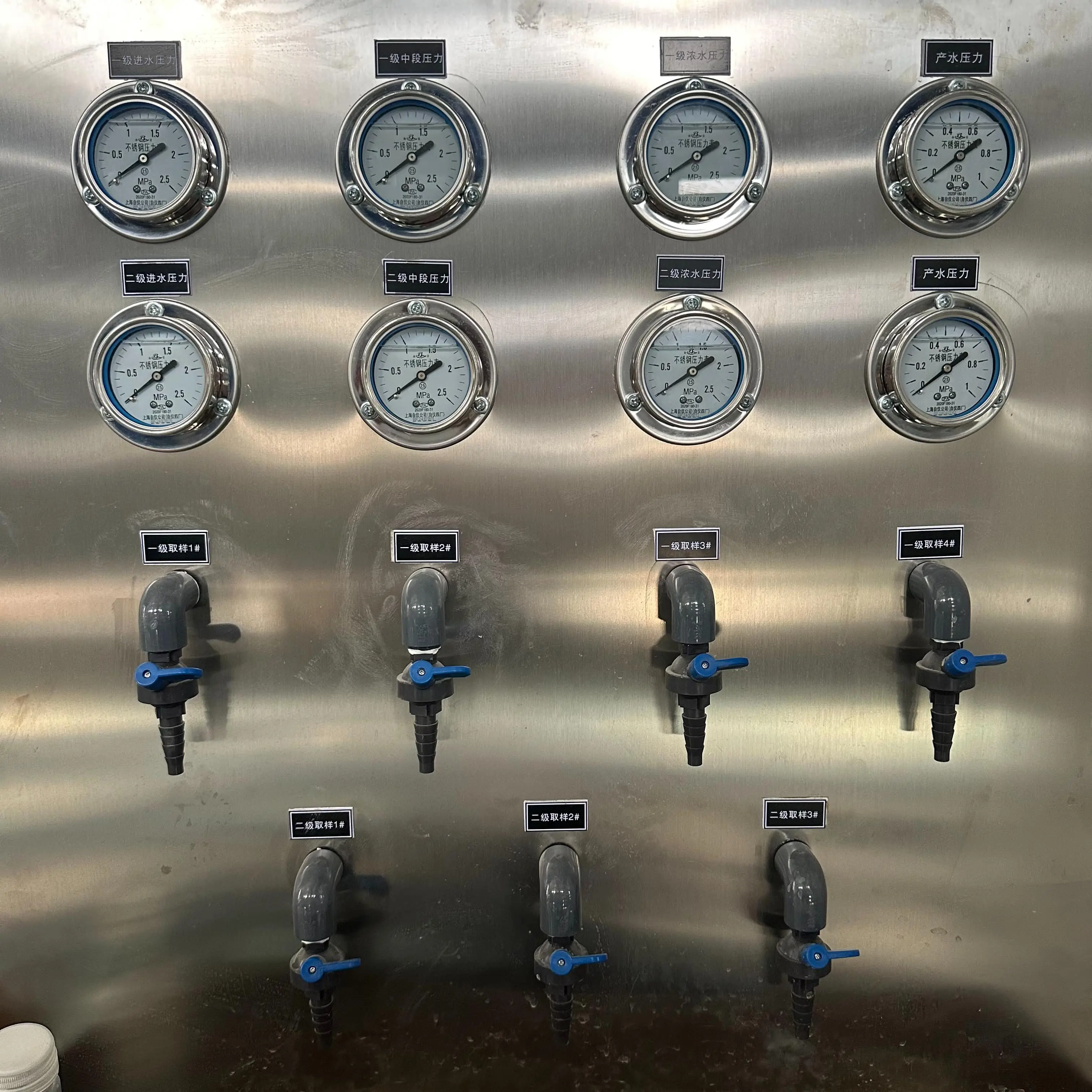
2. Pressure gauge:
The water supply pressure gauge, the first section RO outlet pressure gauge, and the drainage pressure gauge are used to calculate the pressure drop of each section and to standardize the water production and salt permeability. Salt permeability, water production and Δp are used to analyze RO performance problems.
5um filter should be installed with inlet and outlet pressure gauges. When the pressure drop reaches a certain value, the filter element needs to be replaced.
Feed water pump inlet and outlet pressure gauges, inlet and outlet pressure switches are used to shut down the pump when the inlet pressure is low and stop the pump when the outlet pressure is high.
3. Flow meter:
The product water flow meter detects the water output during operation, and each section should be installed separately to facilitate the standardization of RO performance data. The product water flow should be indicated, accumulated and recorded. The concentrated water drainage flow meter detects the drainage volume during operation, and should indicate accumulation and record. From the product flow and drainage flow of each section, the segmented water supply, recovery rate and the recovery rate of the entire RO can be calculated. The feed water flow meter is mainly used for automatic adjustment of RO dosing. In addition to indicating accumulation, it also needs to give signals for proportional adjustment.
4. Conductivity meter:
The feed water conductivity meter and the product water conductivity meter indicate and record the conductivity of water: alarms can be set, and the desalination rate can be calculated from the feed water conductivity and the product water conductivity.
5. pH meter:
When the feed water needs to be acidified to prevent CaCO3 from forming scale, the feed water after acidification needs to be equipped with a pH meter.
6. Chlorine meter:
A chlorine meter is installed on the water supply to control the chlorine content of the inlet water.
7. Oxidation potential meter:
The water supply that has been added with sodium bisulfite to eliminate residual chlorine should be equipped with an oxidation-reduction point meter, which should have indication records and over-limit alarms.