







Unqualified Boiler Softened Water and Its Treatment 2
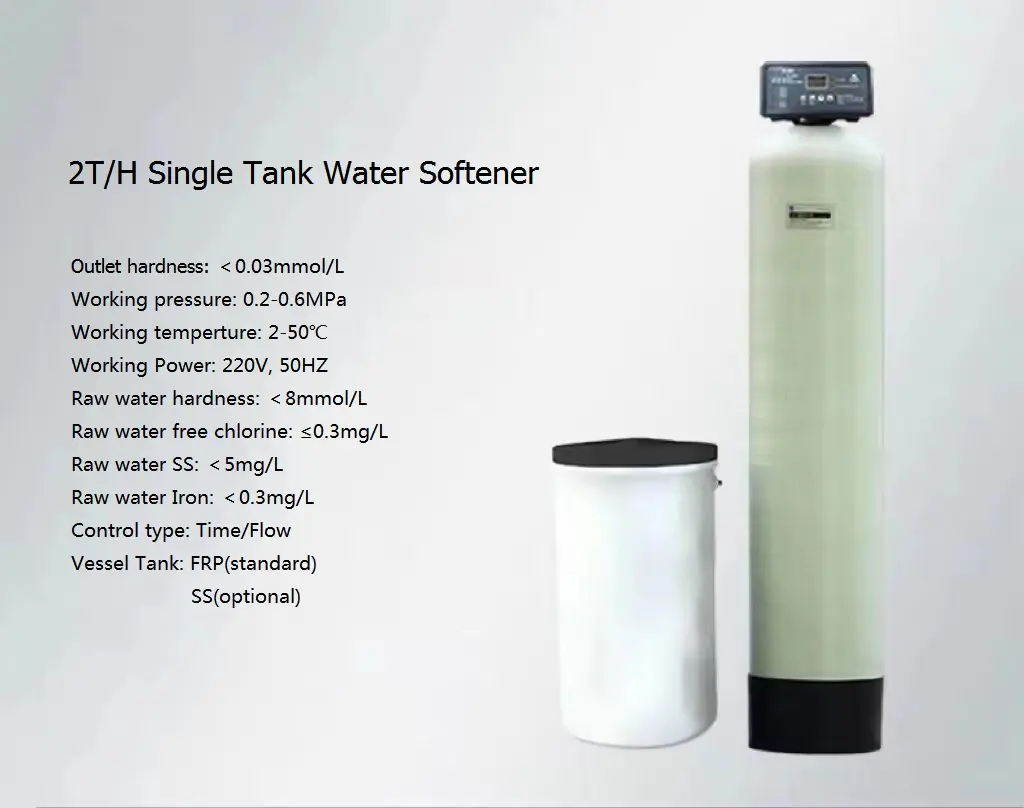
(III) Exceeding the hardness standard for soft water in current water softening equipment is primarily caused by the following:
1. The ratio of the feed water TDS value to the resin bed height or resin exchange capacity is excessive.
Compared to the initial water test with new resin, the feed water TDS requirement for current water softening equipment is more stringent. When the resin bed height is 1.5 meters, the total hardness is 10 mmol/L, and the feed water TDS value is ≥900 mg/L, ensuring a soft water hardness of ≤0.03 mmol/L becomes more difficult.
2. Resin poisoning and loss of exchange capacity.
High Fe⁺ and Al⁺ content in the raw water poisons the resin (this results in the resin color becoming dark red), resulting in a decrease in resin exchange capacity and reduced water production per cycle. Exceeding the standard for soft water hardness due to this cause is a gradual process, not a sudden, noticeable increase.
3. Poor resin regeneration results in a gradual decrease in water production per cycle, resulting in substandard water output at the end of the set water production cycle.
- Insufficient salt in the brine tank. When the water volume in the brine tank is normal but the salt level is less than 1/3 of the water level, the brine absorbed in the middle and later stages of the brine absorption step may be undersaturated, resulting in the brine concentration after dilution by the ejector being lower than the regeneration requirement, affecting regeneration effectiveness.
- The total water volume in the brine tank is too low. For every 100L of resin in the resin tank, the required brine volume is at least 40L. Anything below this value will result in incomplete regeneration.
- The brine absorption is too slow. Sufficient brine cannot be absorbed within the normal timeframe. The reasons for this are described in the second item - No or Slow Salt Absorption.
- The regeneration flow rate is too fast or the regeneration method is incorrect, meaning the tank and ejector are not compatible.
4. A large amount of gas is present in the resin tank. This gas may come from aeration in the feed water or from a loose air check valve during the slow wash process.
5. Large-grain, non-iodized salt is not used.
6. Incomplete backwashing, resulting in contamination of the exchanger with suspended matter, agglomeration, and biased flow.
7. Internal leakage of the control valve: When there is internal leakage of a general control valve, water often flows out of the soft water outlet and the waste water outlet at the same time.