







Unqualified Boiler Softened Water and Its Treatment 1
(I) Softening Equipment Outputs Qualified Water, but Soft Water Tank Water Exceeds Standard
If the water hardness in the soft water tank exceeds the standard, but the water sampling port on the softening equipment tests qualified, this indicates that the softening equipment's water production is unstable and excessive water has been injected into the soft water tank.
Possible causes include:
1. The regeneration cycle is set too long (time-dependent) or a flow meter malfunction causes inaccurate metering (flow-dependent), preventing the resin from regenerating when it should, resulting in excessive water entering the soft water tank. This can also occur due to rust on the impeller or poor water quality, causing the impeller to rotate poorly.
2. The backwash time is too short, causing some of the waste brine that should have been flushed out during the backwash to be carried into the soft water tank.
3. Instable feed water pressure can lead to insufficient water replenishment to the brine tank, resulting in insufficient brine absorption and insufficient backwash. Any of these factors can cause the output water hardness to exceed the standard after regeneration, affecting the water quality of the soft water tank.
4. When the salt tank is low on salt, it is not added promptly, resulting in poor regeneration results.
5. Improper operation, closing the water supply valve during a regeneration cycle.
6. The bypass ball valve is open or leaking.
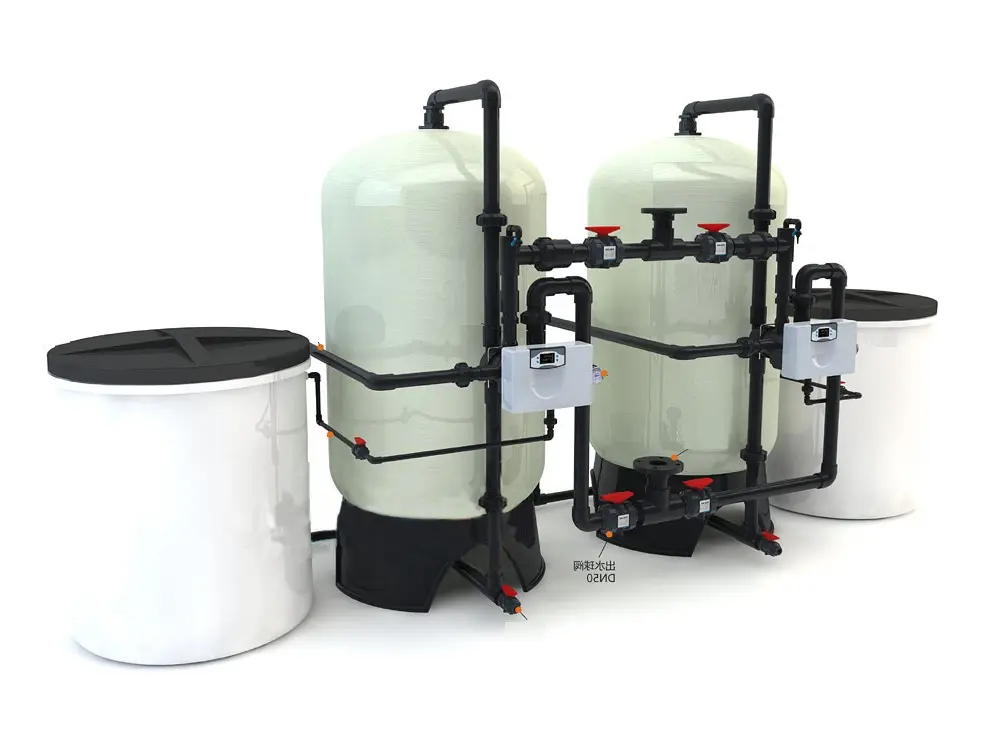
(II) Multiple tests at the sampling port of the Water Softener have failed.
1. The water hardness exceeds the specified limit during the initial water test of a newly installed water softener.
Possible causes:
* The O-ring on the center tube is not forming a seal.
* The length and outer diameter of the center tube meet the requirements (after gluing, place the center tube of the distributor into the tank.
* The end of the center tube must not be 2mm above the tank opening and not 5mm below the tank opening).
Note: The national standard and American standard center tubes differ; the connection dimensions of the valve and center tube must conform to the same standard.
* The center tube O-ring was forgotten to be installed or it fell off during installation.
* The center tube O-ring is damaged.
* The center tube is damaged or cracked.
2. The ratio of the feed water TDS value to the resin layer height is too large. The inlet water hardness requirement for the primary sodium ion exchanger is <6.5 mmol/L.
3. The ratio of the feed water TDS value to the resin exchange capacity is too large.
4. The operating flow rate is too high. Prolonged operation at the maximum allowable flow rate is strictly prohibited.
5. The inlet and outlet are connected incorrectly.
Note: The operating flow rate for a co-current regeneration fixed bed specified in GB/T18300 is 20-30 m/h. The upper limit is the instantaneous maximum value. Prolonged operation at this flow rate is strictly prohibited.