









Process Analysis of Ultrafiltration Membranes in Water Treatment Applications (II)
Water Supply Quality Adjustment
【Adjustment of Water Supply Temperature】
The permeability of Ultrafiltration Membranes is directly related to temperature. The permeation rate of ultrafiltration membrane modules is generally tested with pure water at 25℃. The permeation rate of ultrafiltration membranes is directly proportional to temperature, with a temperature coefficient of approximately 0.02/1℃. That is, for every 1℃ increase in temperature, the permeation rate increases by approximately 2.0%. Therefore, when the water supply temperature is low (e.g., <5℃), heating measures can be used to operate at a higher temperature to improve efficiency. However, excessively high temperatures are also detrimental to the membrane, leading to changes in membrane performance. In this case, cooling measures can be used to lower the water supply temperature.
【Adjustment of Water Supply pH】
Ultrafiltration membranes made of different materials have different pH ranges. For example, cellulose acetate membranes are suitable for pH = 4–6, while PAN and PVDF membranes can be used in the pH range of 2–12. If the influent exceeds this range, adjustment is necessary. Commonly used pH adjusters include acids (HCl and H₂SO₄) and alkalis (NaOH). Since inorganic salts in the solution can permeate through the ultrafiltration membrane, there are no issues with concentration polarization or scaling caused by inorganic salts. Therefore, their impact on the membrane is generally not considered during the pretreatment water quality adjustment process. The focus is on preventing the formation of the colloidal layer, membrane fouling, and clogging.
Correct Mastery and Execution of Operating Parameters Operating parameters are extremely important for the long-term and stable operation of the ultraFiltration System. These parameters generally include: flow rate, pressure, pressure drop, concentrate discharge rate, recovery ratio, and temperature.
A.
Flow Rate: Flow rate refers to the linear velocity of the feed solution (supply water) flowing over the membrane surface. It is a crucial operating parameter in ultrafiltration systems. A high flow rate not only wastes energy and generates excessive pressure drop but also accelerates the degradation of the ultrafiltration membrane's breaking performance. Conversely, a low flow rate increases the thickness of the boundary layer formed on the membrane surface, causing concentration polarization, which affects both the permeate rate and the permeate quality. The optimal flow rate is determined experimentally.
Hollow fiber ultrafiltration membranes, when the inlet water pressure is maintained below 0.2 MPa, exhibit a flow velocity of only 0.1 m/s at internal pressure, indicating a fully laminar flow pattern. External pressure membranes can achieve higher flow velocities. For capillary ultrafiltration membranes, when the capillary diameter reaches 3 mm, the flow velocity can be appropriately increased, which is beneficial for reducing the concentration boundary layer.
Two issues must be pointed out: First, the flow velocity cannot be arbitrarily determined, as it is related to the inlet pressure and the feed liquid flow rate. Second, for hollow fiber or capillary membranes, the flow velocity is inconsistent at the inlet end. When the concentrate flow rate is 10% of the feed liquid flow rate, the outlet velocity is approximately 10% of the inlet velocity. Furthermore, increasing the pressure increases the permeate flow rate but contributes very little to increasing the flow velocity. Therefore, increasing the capillary diameter and appropriately increasing the concentrate discharge rate (recirculation flow rate) can improve the flow velocity, especially during ultrafiltration concentration processes, such as the recovery of electrophoretic paint, which can effectively increase the ultrafiltration rate.
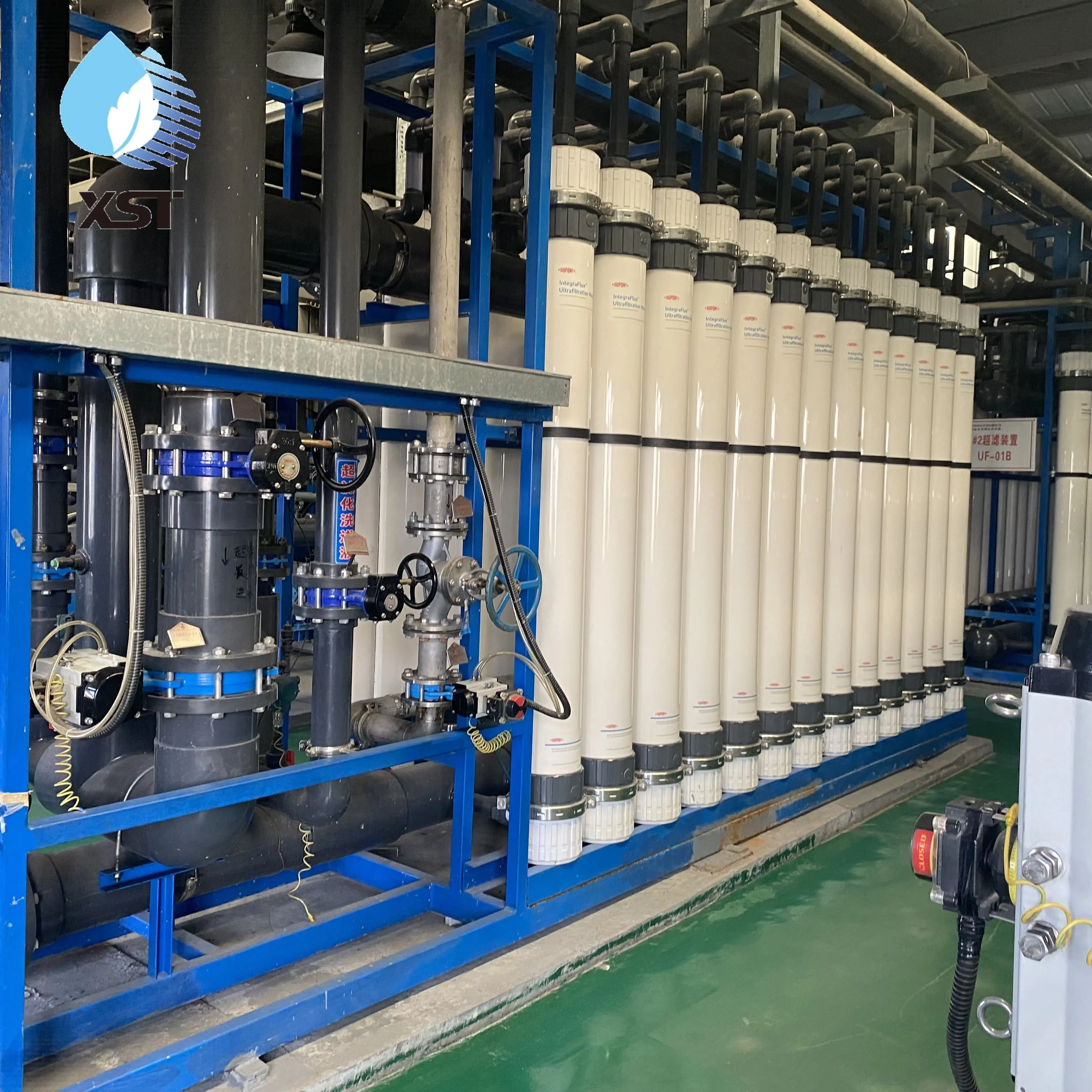
Within the permissible pressure range, increasing the water supply and selecting the highest flow rate is beneficial for ensuring the performance of hollow fiber ultrafiltration membranes.
B.
Pressure and Pressure Drop: The operating pressure range of hollow fiber ultrafiltration membranes is 0.1–0.6 MPa, which generally refers to the operating pressure typically used for treating solutions within the defined domain of ultrafiltration. Separating substances of different molecular weights requires selecting ultrafiltration membranes with corresponding molecular weight cutoffs, thus the operating pressure will also differ. Generally, for hollow fiber inner-pressure membranes with plastic shells, the shell pressure resistance is less than 0.3 MPa, and the hollow fiber pressure resistance is generally also less than 0.3 MPa. Therefore, the operating pressure should be less than 0.2 MPa, and the pressure difference across the membrane should not exceed 0.1 MPa. External-pressure hollow fiber ultrafiltration membranes can withstand pressures up to 0.6 MPa, but for plastic-shell external-pressure membrane modules, the operating pressure is also 0.2 MPa. It must be pointed out that because the inner-pressure membrane has a larger diameter, when used as an external-pressure membrane, it is easily flattened and cut at the bonding point, causing damage. Therefore, inner and outer-pressure membranes are not interchangeable.
When a certain pressure is required for the ultrafiltrate to be used in the next process, a stainless steel-cased ultrafiltration membrane module should be used. This hollow fiber ultrafiltration membrane module can operate at a pressure of 0.6 MPa, while supplying ultrafiltrate at a pressure of 30 m water column, or 0.3 MPa. However, the pressure difference between the inside and outside of the hollow fiber ultrafiltration membrane must be maintained no greater than 0.3 MPa.
When selecting the operating pressure, in addition to considering the pressure resistance of the membrane and casing, the membrane's compressibility and fouling resistance must be considered. Higher pressure results in greater permeate flow, but also a greater accumulation of trapped substances on the membrane surface, leading to increased resistance and a decrease in the permeate rate. Furthermore, particles entering the membrane micropores are more likely to clog the channels. In short, choosing a lower operating pressure whenever possible is beneficial for fully utilizing the membrane's performance.
The pressure drop of a hollow fiber ultrafiltration membrane module refers to the difference between the pressure at the feed inlet and the pressure at the concentrate outlet. The pressure drop is closely related to the water supply rate, flow rate, and concentrate discharge rate. Especially for internal pressure hollow fiber or capillary ultrafiltration membranes, the flow velocity and pressure on the membrane surface gradually change along the water flow direction. The greater the supply water volume, flow velocity, and concentrate discharge, the greater the pressure drop, resulting in the downstream membrane surface pressure failing to reach the required operating pressure. This will affect the total water production of the membrane module. In practical applications, the pressure drop should be controlled to avoid excessive levels. As operating time increases, fouling increases flow resistance, leading to a greater pressure drop. When the pressure drop exceeds the initial value by 0.05 MPa, cleaning and unblocking of the water path are necessary.
C.
Recovery Ratio and Concentrate Discharge: In an ultrafiltration system, the recovery ratio and concentrate discharge are mutually restrictive factors. The recovery ratio refers to the ratio of permeate to supply water, while the concentrate discharge refers to the amount of water discharged before permeation. Because the supply water volume equals the sum of the concentrate and permeate water volumes, a large concentrate discharge results in a small recovery ratio. To ensure the normal operation of the ultrafiltration system, the minimum concentrate discharge and maximum recovery ratio of the module should be specified.
In general water treatment projects, the recovery ratio of hollow fiber ultrafiltration membrane modules is approximately 50-90%. The selection depends on various factors, including the composition and state of the feed solution, the amount of substances that can be retained, the thickness of the fouling layer formed on the membrane surface, and its impact on the permeate flow rate. In many cases, a lower recovery ratio can be used, with the concentrate discharged back into the feed system. This increases the circulation volume, reducing the thickness of the fouling layer and thus improving the permeate rate, sometimes without increasing energy consumption per unit of permeate production.
D.
Operating Temperature: The permeability of ultrafiltration membranes increases with increasing temperature. Generally, the viscosity of aqueous solutions decreases with temperature, thus reducing flow resistance and correspondingly increasing the permeate rate. The actual temperature of the supply solution at the working site should be considered in the engineering design.
Especially with seasonal changes, temperature regulation should be considered when the temperature is too low; otherwise, the permeate rate may vary by about 50% with temperature changes. Furthermore, excessively high temperatures will also affect membrane performance. Under normal circumstances, the working temperature of hollow fiber ultrafiltration membranes should be 25±5℃. If higher temperature conditions are required, high temperature resistant membrane materials and shell materials can be selected.